Transitional periods: how does the move from MDD to MDR work?
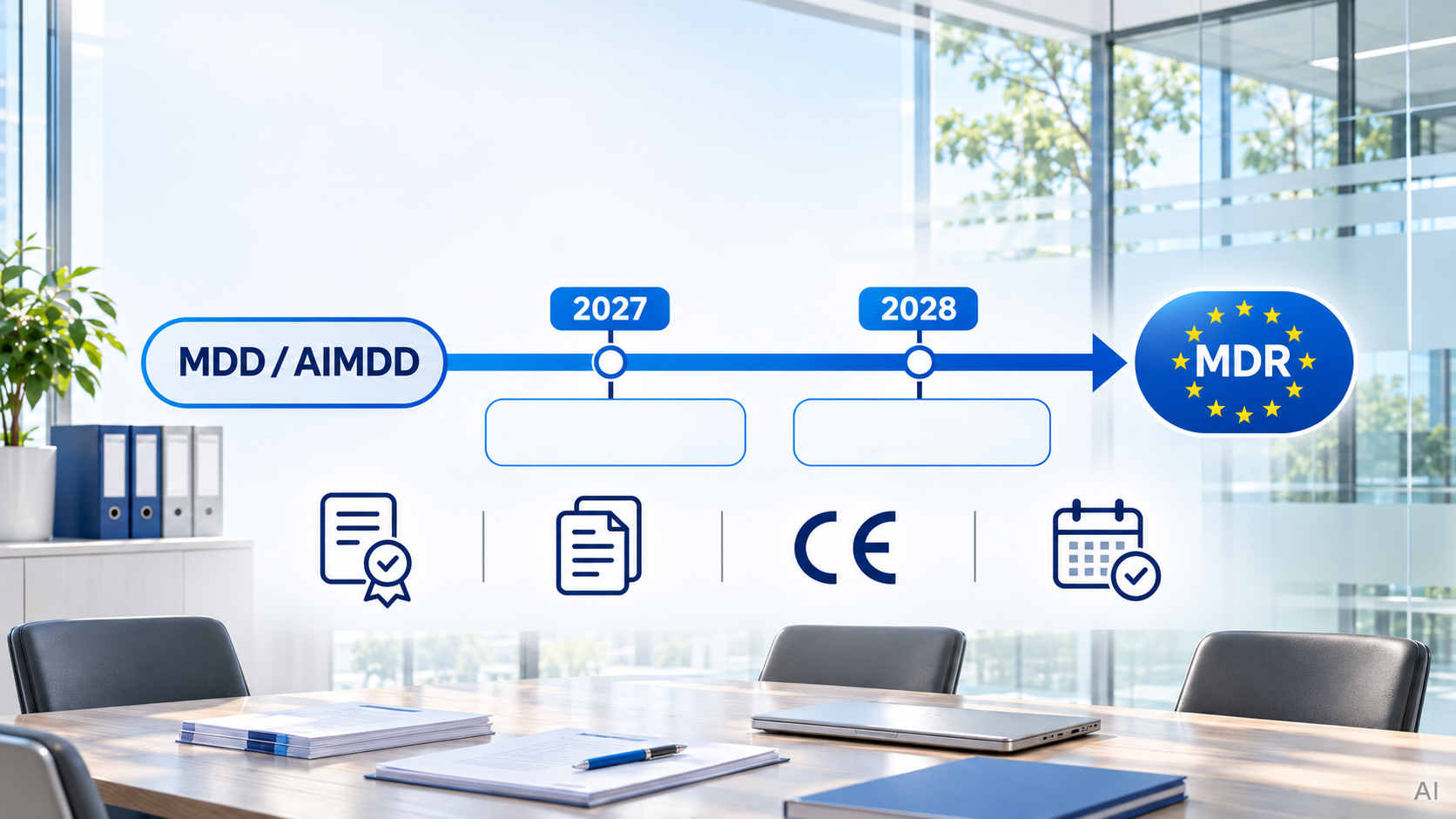
Certain devices complying with the MDD or AIMDD can use conditional transitional periods until the end of 2027 or 2028. We explain which devices qualify and what evidence manufacturers should already hold.

Key Takeaways
- The extension introduced by Regulation (EU) 2023/607 applies to specified devices and requires compliance with the conditions in Article 120 MDR.
- The 31 December 2027 deadline covers all class III devices and certain class IIb implantable devices.
- For the other groups covered by the extension, the deadline is generally 31 December 2028.
- A QMS and formal application to a notified body were required by 26 May 2024; a written agreement with the notified body was required by 26 September 2024.
- A significant change in design or intended purpose may prevent the changed device from using the transitional provisions.
- Removing the sell-off deadline does not extend a product’s shelf life.
In this article
- Why do some devices still rely on the MDD?
- Which devices qualify for the extension?
- Until when can eligible devices be placed on the market?
- 31 December 2027
- 31 December 2028
- 26 May 2026: a separate period has already ended
- Which conditions had to be met?
- What if the expiry date printed on a certificate has passed?
- Which obligations apply during the transitional period?
- What is a significant change?
- What does this mean in practice?
- Hypothetical example: two versions in one family
- Must stock be withdrawn when the period ends?
- How can Neximed help organize the work?
- What should be checked now?
- Sources & references
- Frequently Asked Questions (FAQ)
Why do some devices still rely on the MDD?
The MDR has generally applied since 26 May 2021. It replaced the MDD, Directive 93/42/EEC, and the AIMDD, Directive 90/385/EEC. However, Article 120 introduced specific provisions allowing certain devices complying with the former directives to continue being placed on the market. 1 2
Regulation (EU) 2023/607 extended these periods subject to specific conditions. A manufacturer can continue placing an eligible device on the market while preparing for conformity assessment under the MDR. The extension applies only to the groups defined in the legislation. 3 7
These products are known as legacy devices. For each product, check its history, declaration or certificate and compliance with every condition. The fact that a product was once sold with a CE marking does not establish its current status.
Which devices qualify for the extension?
The provisions primarily cover two groups:
- devices with a relevant certificate issued under the MDD or AIMDD whose validity follows from Article 120(2),
- devices for which the MDD did not require a notified body, a declaration of conformity was drawn up before 26 May 2021, and the MDR now requires notified body involvement. 1 3
The second group is relevant to certain former class I devices. It does not mean that every class I product has until 2028. A device that remains an ordinary class I device and still does not require a notified body receives no general deferral of the MDR on that basis. 3
Until when can eligible devices be placed on the market?
31 December 2027
This deadline applies to all class III devices and class IIb implantable devices, except the groups listed in Article 120(3a)(a). Those exceptions include sutures, staples, dental fillings, dental braces, tooth crowns, screws, wedges, plates, wires, pins, clips and connectors. 1
The exception applies to the specified group of class IIb implantable devices. It must not be interpreted as automatically moving any device on that list to the 2028 deadline regardless of its class.
31 December 2028
This deadline covers the remaining class IIb devices, class IIa devices and class I devices placed on the market in sterile condition or with a measuring function, provided the relevant conditions are met. Devices covered by Article 120(3b), for which notified body involvement became mandatory only under the MDR, can also use the transition until the end of 2028. 1 3
Classification under the MDR determines the end of the transitional period. The class shown on an old MDD certificate may therefore be insufficient to select the correct deadline. 3
26 May 2026: a separate period has already ended
The separate provision in Article 120(3f) covered class III custom-made implantable devices. It allowed them to be placed on the market without the certificate required by the relevant MDR procedure until 26 May 2026, subject to a timely application and agreement with a notified body. This special period had already ended by the verification date of this article. 1 3
Which conditions had to be met?
Article 120(3c) sets cumulative conditions. An eligible device must continue to comply with the MDD or AIMDD, must have no significant changes in design or intended purpose, and must not present an unacceptable risk to the health or safety of patients, users or other persons, or to other aspects of public health protection. 1
There were also conditions with specific dates:
- By 26 May 2024, the manufacturer had to put in place a QMS in accordance with Article 10(9) MDR.
- By 26 May 2024, the manufacturer or authorized representative had to lodge a formal application with a notified body for conformity assessment of the relevant device or a device intended to replace it.
- By 26 September 2024, the manufacturer and notified body had to sign a written agreement in accordance with the relevant requirements of Annex VII. 1 3
In 2026, these dates are in the past. The review must establish whether the required actions were completed on time and covered the device concerned. A request for a quotation is not a formal application, and discussions about working together do not replace a signed agreement.
By May 2024, the QMS had to address how compliance with the relevant MDR requirements would be achieved. The Commission also explained that, for legacy devices, some of these requirements did not yet have to be fully implemented at device level. Distinguish the system's readiness to transition to the MDR from completion of the assessment of a particular product. 3
What if the expiry date printed on a certificate has passed?
In certain cases, certificate validity was extended by law. The printed date alone may therefore not mean that a certificate is no longer valid. However, the extension does not apply to every expired certificate. 1 3
Article 120(2) covers relevant certificates issued from 25 May 2017 that were valid on 26 May 2021 and were not subsequently withdrawn. Additional conditions apply to certificates that expired before 20 March 2023. These include an earlier agreement with a notified body or an appropriate decision by the competent authority. 1 3
As practical evidence of status, collect the old certificate, its device scope, the manufacturer's declaration that the conditions are met and confirmation from the notified body. The Commission's Q&A describes these supporting documents. They do not replace the legal conditions or create eligibility that the device does not have. 3
Which obligations apply during the transitional period?
Article 120(3d) requires the MDR provisions on post-market surveillance, market surveillance, vigilance and registration of economic operators and devices to apply in place of the corresponding directive provisions. Appropriate notified body surveillance is also required for devices covered by the relevant certificate and agreement. 1 4
This does not automatically make every MDR requirement applicable to a legacy device. For example, the Commission states that legacy devices are not subject to MDR requirements for UDI assignment. EUDAMED registration and the identifiers used for that purpose need a separate assessment. 3 4
The first four EUDAMED modules have been mandatory since 28 May 2026. When reviewing a portfolio, consider the specific registration rules and deadlines for devices already on the market. The phased rollout of the database does not exempt manufacturers from PMS or incident reporting obligations. 5
What is a significant change?
During the transitional period, the impact of a change on the design or intended purpose must be assessed. MDCG 2020-3 rev.1 contains flowcharts and examples to help distinguish significant from non-significant changes. Applying them requires consideration of the particular device and the scope of the modification. 6
An extension of the intended purpose or the introduction of a new patient population may lead to a change being assessed as significant. Document corrections and software updates do not all have the same status. A company's internal category of "major change" must not be treated as equivalent to the regulatory term in Article 120.
If a planned modification is significant, the changed device requires the appropriate MDR conformity assessment before it is placed on the market. Complete the assessment before implementing the change in production and labeling. 6
What does this mean in practice?
Review individual devices and configurations instead of assigning a single "company in transition" status. The recommended sequence is:
Reviewing transitional conditions
- 01Identify the device
Identify the device, old certificate or declaration and relevant transitional group.
- 02Confirm the MDR class
Confirm the MDR class used to determine the final deadline.
- 03Gather dated evidence
Collect evidence of the QMS, formal application and agreement bearing the required dates.
- 04Review surveillance and changes
Check current notified body surveillance and the change history.
- 05Assess ongoing obligations
Assess PMS, vigilance and registration activities.
- 06Schedule MDR assessment
Set a schedule to complete MDR assessment with time to resolve gaps.
Hypothetical example: two versions in one family
Practical example
- Situation
A manufacturer has a legacy device covered by a timely application and agreement with a notified body. In 2026, it plans a new version with an extended intended purpose.
- Problem
The team initially assumes that a shared family name gives both versions the same status.
- Approach
It assesses the status of the existing configuration and the regulatory effects of the planned change separately. If the change is significant, the new version needs the appropriate MDR assessment before being placed on the market.
- Takeaway
Continued placing on the market of the old version depends on maintaining its own transitional conditions.
Must stock be withdrawn when the period ends?
Distinguish placing on the market from subsequent making available. Placing on the market is the first making available of an individual device on the EU market. Transitional provisions therefore do not apply solely at model-name level. 1
Regulation 2023/607 removed the general deadline for further making available, known as the sell-off date. Devices lawfully placed on the market before the relevant deadline may continue to be made available or put into service. Their shelf life, storage conditions and safety requirements still apply. 3
Keeping a product in the manufacturer's warehouse does not prove that it was already placed on the market. For stock, establish its actual stage in the supply chain and retain the relevant evidence.
How can Neximed help organize the work?
Review findings may call for corrective actions and training. CAPA in Neximed allows actions, deadlines and evidence of completion to be assigned and effectiveness to be assessed. Training supports training plans and records, as well as evaluation of training effectiveness.
The platform does not give a device legacy status or extend a certificate. A discussion of the process helps define how to manage the tasks resulting from the manufacturer's assessment.
Organize actions for the transition to MDR
Discuss how to manage CAPA actions and training resulting from a portfolio review.
What should be checked now?
Checks to carry out now
- Does the device meet the conditions for the relevant group under Article 120?
- Does the correct deadline follow from MDR classification?
- Was the QMS put in place by 26 May 2024?
- Is there evidence that the formal application was submitted on time?
- Was the agreement with the notified body signed by 26 September 2024?
- Have the validity and scope of the old certificate been confirmed?
- Has the effect of every implemented change on transitional status been assessed?
- Does the MDR assessment schedule allow time for responses and supplementary information?
- Have stock status and registration obligations been established separately?
Verified on 15 October 2026. Educational material on the EU market. A particular device's eligibility for a transitional period requires assessment of its documents and change history.
Sources & references
- 01
- 02
- 03
- 04
- 05
- 06
- 07
This article is for information only and does not replace an individual regulatory or legal analysis. Always check the current text of the regulations, the relevant guidance and the specifics of your device.
Frequently Asked Questions (FAQ)
Can a first application be submitted now to obtain an extension until 2028?
Must an old certificate be reprinted with a new expiry date?
Does an MDR certificate prevent a legacy version being placed on the market in parallel?
Do all implantable devices have until the end of 2028?
Does removing the sell-off date allow expired products to be sold?
Does the December 2025 proposal to revise the MDR change these deadlines?
The NexiMed team working on quality management systems and regulatory compliance for medical device manufacturers.
See also
 Quality management
Medical device classification: what is it and why is it used?
A device’s class affects conformity assessment and some obligations after sales begin. We explain how to determine it under the MDR and why a similar appearance does not mean that two products belong to the same class.
 Quality management
Medical device manufacturer obligations: from design to post-market surveillance
Manufacturers remain responsible for device conformity after sales begin. We explain MDR obligations, how to assign them across the organization, and the rules for documentation, incidents and continuity of supply.
 Quality management
ISO 13485: how does standardization support medical device safety?
ISO 13485 structures quality management for organizations involved in the medical device life cycle. Its contribution to safety comes from controlling processes, competence and changes that can affect the device.
 Quality management
What is MDR and what does it require of medical device manufacturers?
MDR sets the rules for placing medical devices on the European Union market and monitoring them. We explain manufacturers’ obligations and what they mean for design, production and work after sales begin.